
The Goal
Transfer the healthiest possible yeast to fermentation at the optimal point in the growth cycle. Get this right and your fermenters have the best chance at complete sugar conversion. Get it wrong and you’re starting every batch at a disadvantage.
The Challenge
Yeast health depends on precise environmental control - sugar levels around 2%, proper oxygen, adequate nitrogen. Without real-time visibility, you’re dosing enzyme and additives based on guesswork, not data.
The Solution
Continuous measurement of eight key components throughout the propagation cycle. See exactly when yeast is ready. Optimize enzyme and additive dosing. Stop wasting money on unnecessary chemicals.
Real Results from a US Ethanol Plant
The IRmadillo measured eight components continuously throughout propagation, providing the same
data as HPLC - but continuously, in real-time, rather than snapshots, hours later.
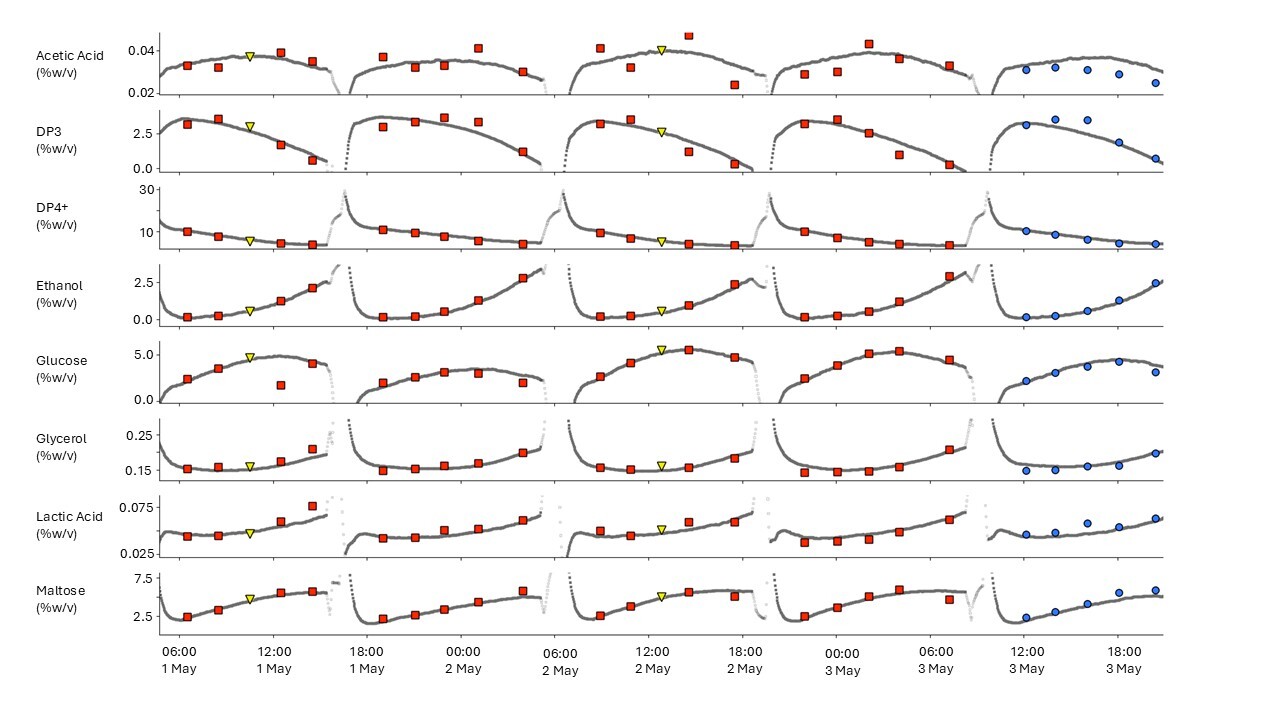
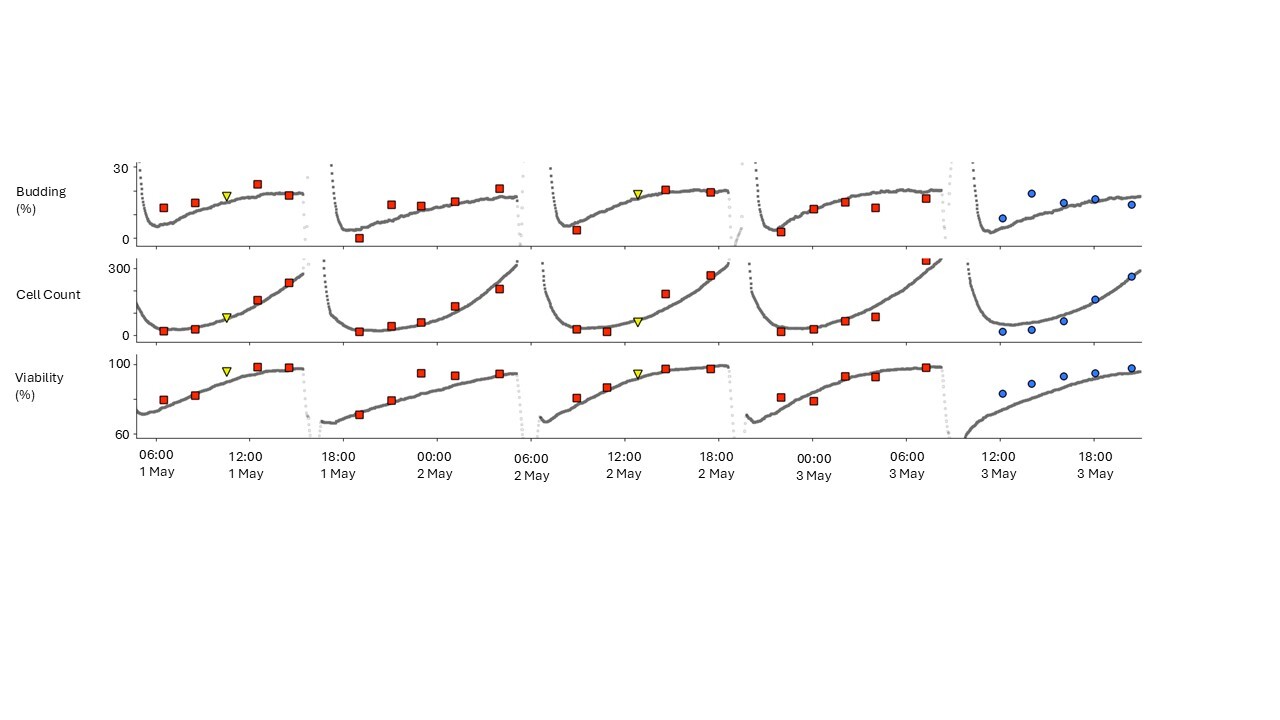
By correlating with various chemical changes linked to yeast metabolism, it was also able to track three
parameters that are normally obtained only by use of a microscope and manual inspection: cell count,
budding and viability.
What this real-time data revealed
IRmadillo lets the producer see exactly when the yeast is in the optimum phase to send to the fermentation: at the end of the exponential growth phase, when budding and viability are still high. They can also see immediately if viability starts to decline.
Enzyme activity is also visible, with glucoamylase breaking mash down into glucose in real-time. The plant is able to adjust dosing to maintain sugar levels around 2% - enough to feed yeast, not enough to cause osmotic stress. This avoids over-dosing of the expensive enzyme.
Ethanol production signals oxygen problems:
Ethanol shouldn’t build up during propagation - you want biomass gain, not fermentation. If ethanol starts climbing, oxygen levels are too low and anaerobic pathways are activating. Adjust aeration before yeast health suffers.
Acid spikes mean contamination:
Lactic and acetic acid increases signal bacterial contamination. Catch it early and dose antibiotics before the infection spreads to fermentation. Wait too long and you’re treating infected fermenters instead of preventing the problem.
Glycerol tracks yeast stress:
Rising glycerol means yeast is stressed. Make adjustments to keep yeast happy and productive - temperature, sugar levels, oxygen - before stress impacts cell counts and viability. Nitrogen management becomes precise: The IRmadillo measures FAN (freely available nitrogen) and PAN (primary amino nitrogen) - nutrients critical for yeast metabolism. Balance nitrogen addition to hit optimal levels without wasting expensive urea or ammonia.
What this means for your operation
Hit the optimal transfer point every batch. See when yeast is at peak health and viability. Transfer to fermentation at exactly the right moment - not too early (low cell counts), not too late (declining viability).
Reduce chemical costs.
Stop over-dosing glucoamylase, urea, ammonia, and antibiotics. Use exactly what’s needed based on real-time measurements, not safety margins and guesswork.
Prevent fermentation problems before they start.
Contamination caught in propagation doesn’t spread to fermenters. Poor yeast health fixed in propagation doesn’t become stuck fermentation.
Map your entire propagation process.
Understand exactly how process changes affect yeast growth. Build institutional knowledge about what optimal propagation looks like in your facility.
Installation
Installs directly in propagation tank or recirculation line. C1D2 certified for hazardous environments. Measures continuously with no moving parts, no sampling systems, no maintenance.
Plant-Wide Applications
The same instrument monitors fermentation, distillation, and liquefaction. One technology platform across your entire operation.
The Bottom Line
Propagation is the foundation of successful fermentation. Healthy yeast at the optimal moment sets up every batch for complete sugar conversion and maximum ethanol yield. Real-time monitoring turns propagation from an art into a science - repeatable, optimizable, and profitable.